
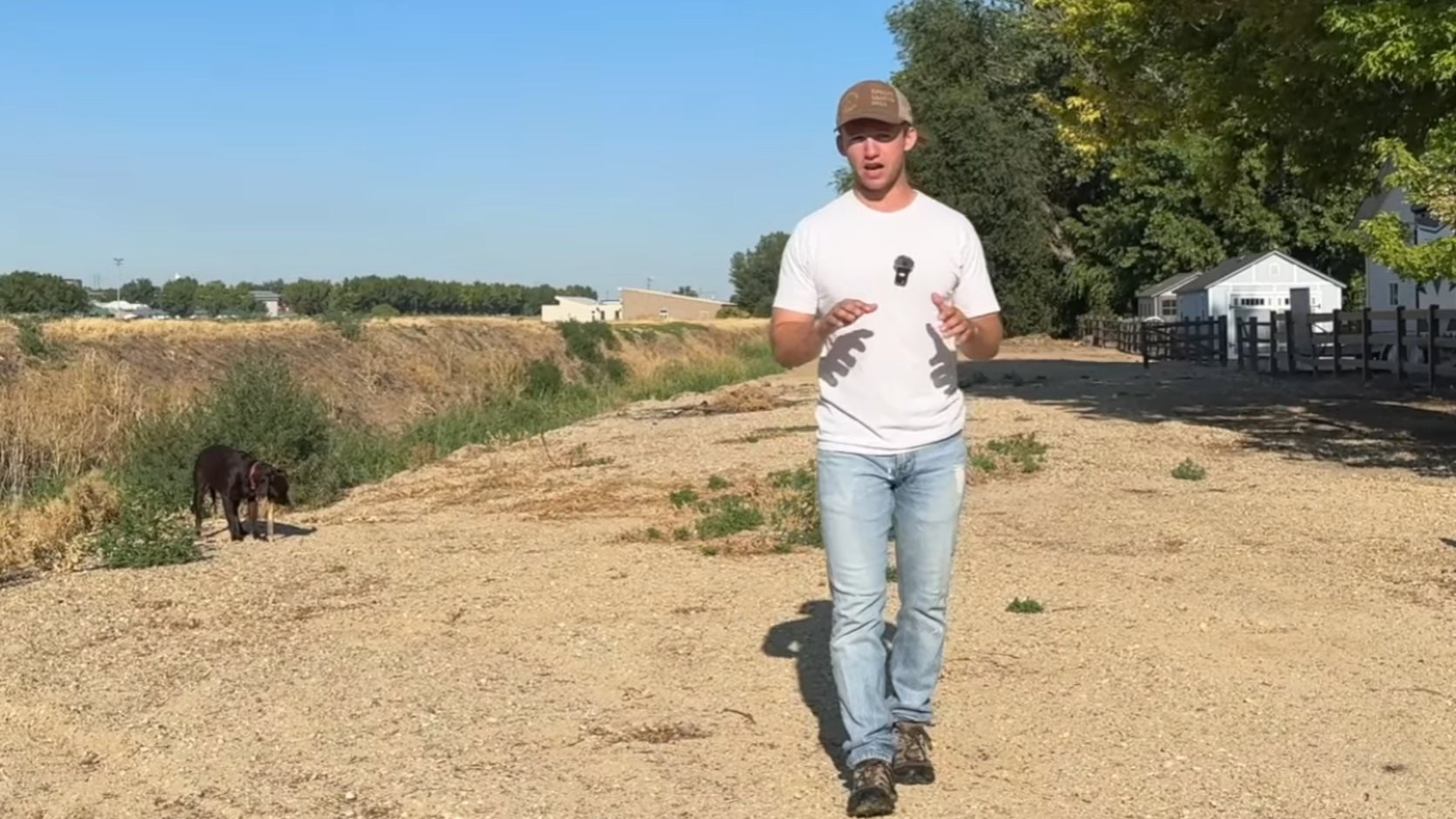
The biggest mistakes when buying an acreage property in Idaho are buying land without the irrigation water you need, guessing where the property lines are, and missing easement or access problems. These three are often the hardest to fix after closing. Buyers should also check the well, septic system, irrigation setup, utility costs, neighbors, planned growth nearby, and county rules for splitting land or building.
Picture 5 acres of green pasture. Horses, a hay field, maybe a few steers. Now picture it brown.
That can happen when an Idaho acreage doesn't come with irrigation water. Under Idaho's domestic well exemption, a household well can generally water up to half an acre, within the exemption's total water-use limit. If there's no other water for the rest, you may not have a legal or practical way to water pasture or hay. And in much of the Treasure Valley, getting new water rights later is hard or impossible.
I'm Isaac Crace with Top Idaho Real Estate. I grew up around acreage in the Treasure Valley, and today I help buyers evaluate homes on acreage. Here are 10 mistakes I see buyers make.
Thinking about buying an acreage property in Idaho? There is a lot more to consider than the house and the number of acres.
In this video, I cover some of the biggest things buyers should understand before buying a home on acreage in the Treasure Valley, including irrigation and water rights, wells, septic systems, easements, property boundaries, utilities, neighboring properties, maintenance, and resale.
If you’re moving to Idaho and looking for an acreage property in Nampa, Caldwell, Meridian, Emmett, or elsewhere in the Treasure Valley, this video will help you know what to look for before you buy.
I grew up in the Treasure Valley around acreage properties, and I also work with buyers looking for homes with land throughout the area. These are some of the things I want my clients to understand before they purchase an acreage property.
So, you're thinking about living on some acreage in Idaho. Chickens, cows, maybe a shop, but there's a lot to know about buying land in Idaho that can make or break your experience. In today's video, I'm going to go over everything about buying land in Idaho, whether you're looking at properties ready to build on or even places that already have a house ready to go.
Watch THIS Before Buying Land in Idaho 2026
Starting with the most important thing about land and acreage in Idaho is going to be water. This is something that a lot of people forget to take into consideration. In Idaho, we are high desert, which means we really don't get any rain from about June through September during the summer. Now, this is great if you're trying to plan some parties further out, but it's not that great if you're trying to water some crops or keep a field green for your animals.
Because of this, we have to irrigate our properties here in Idaho. Now, irrigation is a term that for many folks who aren't from Idaho is a little bit odd. In short, it's water that we pump directly from our lakes, our rivers, and our reservoirs into systems to be used specifically for landscape watering. So, why do we use irrigation water instead of city water or water from our wells?
Well, irrigation water isn't treated at all. Like I said, it's pumped straight from the lakes, the rivers, the ponds here in the area directly into lines to water our plants, which means it's not potable at all. It also isn't metered. So, if you have irrigation, it is pretty much an unlimited source of water throughout the summer months when you would normally water your yard. And it is assessed kind of like a property tax.
And the going rate for irrigating your land is about a hundred bucks per acre for the entire year. So, you can probably see why we irrigate our... You can probably see why we water our yards with irrigation water instead of water from the city or from your well. It's a lot cheaper.
Not all pieces of land, however, are entitled to irrigation. And the way that we figure this out is by looking at the water rights for a specific property. Not every property in Idaho has water rights. They do play a little bit into your well water, too, but we'll come back to that later.
And I can't stress this enough how important water rights are in Idaho. If you buy a piece of land with no water rights, congratulations. You just bought a worthless pile of dirt that you're probably not going to be able to sell to anyone because it can't be used for anything.
Now, how water actually gets to your property is important as well. Irrigation can come in a whole different slew of ways. Like this ditch behind my house, we have tons of these canals and ditches throughout the entire Boise area in Idaho, for instance.
If you live in a subdivision or you're going to be living in a subdivision, likely there's going to be a community system of some sort. So, the water will be pumped from a reservoir or a pond or whatnot, something like that, through a community system up to your sprinklers. So, you're not going to have to worry about it.
Growing up, however, like on my grandparents' place, they had a small concrete ditch. So once a week we got to go out there, set siphon tubes so that we could flood irrigate their property.
Now what may also be the case is if you have a ditch like this one or even a pond or a river, you might have your own irrigation pump that sits in there. Now this is important to look at because who maintains the irrigation pump? Big irrigation pumps are not cheap. You need to make sure that you have easements to even get to them and work on them.
Now that was a lot of water talk. There's a lot more stuff to cover, so let's get into that.
Old trucks, by the way. If you have any land on acreage, if you're me, for instance, you're going to collect more old trucks. I accidentally just bought two more '79 Ford pickups over the weekend when I was just looking for a part for my Bronco.
Most folks who buy their first larger piece of property find out there's a lot more things to take into consideration than they first thought. Animals are a big one when it comes to this. Satie, come here.
Out of the city and HOAs is a great feeling. Nobody can tell you if you can have or you can't have roosters on your property, what animals you can and can't have, how many dogs you can have, but this also applies to your neighbors.
So, if you have a neighbor who maybe has a tendency to bring home another dog every week that likes to bark non-stop and they don't do anything about it, there's really nothing that you can do about it. There's also noise, no noise ordinances outside of the city limits or anything along those lines.
More than that also is taking care of your own land. You might be doing a phenomenal job keeping the weeds down on your own place, but if the property that you're next to might be neglecting a little bit, like this field behind us, you're going to be spending a lot of time keeping that away, whether it's weeds, pests, anything along those lines.
Story time. Going back to my grandparents' place growing up, they have about 2 acres over on the west side of Nampa, and their pasture is immaculate. No weeds, grass, nicely irrigated, cut every single week. Beautiful.
Growing up, we would always have troubles because the neighbors on either side of them never took care of their property. So, we'd spend the entire summers taking care of weeds that were blowing over, taking care of gophers and pests that were coming over into the nice pasture because the neighbors weren't doing anything about theirs.
What's going on, girly?
Keeping resale in mind when you're purchasing acreage is also very important as well. Now, you might not mind living next to a dairy or a feedlot or someplace that stinks, but that doesn't mean that potential buyers might not like this.
See this? We got warehouses all the way around us. We don't mind it. But is it a deterrent to potential buyers? It can be.
I was selling a house over in Middleton at the beginning of this year. And if you'd like to know more about Middleton, you can find the video link in the descriptions down below. It was right across the street from a big dairy feedlot. The sellers didn't mind the smell, but almost every single buyer that we had that came over was like, "Yeah, no, that smell is a deal breaker."
If you do get chickens, word of the wise, don't let them out year round in your yard because they're cool. You got your free-range eggs, but if you're trying to maintain a nicely manicured landscaping, it can be the death of it.
Your utility cost will also likely be quite different if you're living out in the county or on the countryside versus in the city. Now, Idaho has very, very, very cheap utilities when it comes to natural gas and electric. Idaho Power comes in at about 10 to 14 cents per kilowatt hour on the electric and the natural gas that we have here in the area is like 50% below the national average.
So, it's very cheap to heat your home with natural gas here in the Boise, Idaho area, averaging about 100 to 200 bucks a month during the winter if you're heating your home with natural gas.
Now, you have options to do like a level pay where they just take the average of your wintertime natural gas usage and then just throw it over the summer. So, it's the same month to month. However, this is something to keep in mind if you're looking at potentially buying acreage properties.
Natural gas can be found closer into the city. So, if you find a piece of acreage like what I live on right now, we're just a couple minutes from the interstate and the city. Technically, we're in the county, but the city has grown around us here, and we have natural gas because of that. No other city services. We're on well and septic.
But if you go move out into the countryside in Timbuktu, it's not very unlikely that your house won't have natural gas. You might be on well and septic and then the only utilities you'll have are electric.
Now, if you're heating your house with electric versus natural gas, it can be more expensive. I mean, that is taking into consideration how cheap natural gas here is in Idaho, but it's something to think about.
You can, and people do put propane tanks, LPG tanks on their property and you can heat from that, like if you have a gas stove that you like cooking on or if you have a fireplace. But it is not uncommon to only have electric utilities in houses that are out in the countryside. So that's something to keep in mind.
Now, living outside the city limits, like I was saying, you'll likely be on your own well and septic, so you're not going to be paying your city water and sewer fees. So, you save a little bit of money there.
However, there are some benefits, but also some added responsibilities that you have to take care of that. Takes power to run your well pump. So, you're going to have to pay to do that. You are the only person that there is. If something happens to your well pump, guess what? It's on you to repair it.
Same thing with your septic system. If anything happens to your septic system, that is on you to take care of that.
Now, if you've never lived on a septic system, basically it's like your own home sewer system and you'll have to call somebody like a pump truck and then they'll come and suck out all your crap typically every couple years.
Now, depending on how well you're taking care of the system or how hard it is on it, how many people you have living in the house, there's a whole different variety of factors that can go into it, but on average, you're going to have to call somebody to come out and pump that system every about 2 years.
Now, these septic systems can be more fragile than a normal sewer system if you aren't used to them. You can't flush things down that system like baby wipes or feminine hygiene products or anything along those lines because if you clog that system and you have to replace it, it is not cheap to get an excavation truck to come out here, dig it out, redo the whole thing. You got to get permits because it's a well, you're dealing with crap in the yard. That's not going to be cheap.
Reasonable expectation for pumping your septic system, you're looking at, I'd say, 500 bucks is a pretty reasonable thing every other year. But like I said, it depends on how good you are with maintaining that system, how many people you have in the house, how old the system is, a lot of things like that.
Well, well, well. That's enough talk. Let's get back to wells.
I personally love well water because you don't have the chlorine smell of city water or any of the other stuff that might personally be in city water. However, wells are not perfect.
So depending on where you are, wells can have their own added issues. For instance, higher mineral contents in your wells or if your water in your well is really hard, you might have to add an extra filtration system in your house or a water softener system in your house.
We have that because in our well, we have pretty high iron. And you can actually notice this driving around properties looking to see how the wells are, if they have a high mineral content by looking at the concrete, like the driveways around the houses or the concrete curbing around the houses. If they have a lot of red or kind of staining on the concrete, that means it's got a high iron content in those wells.
Another thing that you'd look out for, and this is more if you get way further out of town, certain areas, you can have a high sulfur content in the well, and that's that nasty hard-boiled egg smell that you get, and I just don't like that at all.
So, you might even have to add in additional filtration systems like an RO system if you have a well that has issues with that.
There can be some tax advantages, however, to living on acreage. Now, there's a whole lot of stipulations on how those go through. Like with an agricultural exemption, if you're on over five acres, then there's also ways that you can get it based on what your livestock output is and that kind of thing.
But where I live right now on an acre in Nampa, I moved from a place in town, just normal city lot, nothing fancy, 20-year-old home. And when we moved to our place out here on an acre just outside of city limits, not only did our taxes go down because we're outside of city limits, but we got a bigger property and our taxes are lower because we are not inside of the city limits.
Where your land and boundaries are are extremely important on acreage. So, if you're ever looking to purchase a property on acreage, I highly recommend a survey just to figure out where the property lines actually lie to keep yourself out of legal trouble or potential legal trouble in the future. Every single year, people go to court for this, so it's just better to be safe than sorry.
But another thing that we need to be cognizant of in Idaho are easements. And an easy way of seeing what an easement is is if you might not own a property, but you have a right to travel through that property or access a different property through that one.
Now, a common easement would be like the one that we're on right now. This is my property. I own all the way to the middle of this canal over here, but I can only build my fence up to that point because I need to leave this open for an easement.
This is an irrigation easement. So the irrigation company can come clean the ditch, do anything like that that they need to do.
Another type of easement that we can see and do come across is say you have a piece of land and you have another one up above it that's landlocked. They can have an easement through the first piece of land to get to the back property, property B.
They may not own property A, but they have a right to use that. So, you might not be able to, if you buy property A, you can't just fence it around. That's something that you need to be cognizant of that even though you might be purchasing property A, you still have a piece of that property that you're not actually able to do anything with.
All right, watch out, lady.
So, where are you going to find acreage properties here in Idaho? As a general rule of thumb, the further you go out from the center of town, the more acreage properties you are going to find.
When I have clients who are looking for acreage, they don't necessarily care which specific town it might be technically located in as long as it fits their criteria and most of all their budget. That's going to be the biggest thing of all is finding one that fits the budget.
Now, that's not to say that you can't find properties closer into town, but the larger properties closer into the hearts of town, you're just going to have to be prepared to open your pocketbook for.
If we look at availability and pricing at the time of making this video on the MLS, if we put in search criteria for 1 acre in specific cities, it really helps break down the area, prevalence of properties, and what kind of price points you're looking at.
I've got a sheet right here, so I've got all these numbers written down on this.
In the city of Boise, there are 19 homes that fit this criteria. Keep in mind, Boise is the biggest city in Idaho. It's almost 250,000 residents now, I believe. So, they've got 19 homes that fit this criteria, and you really have to be around the million-dollar mark to get into that market.
Eagle has 10 homes that fit this criteria. And to get into those homes, you really have to be in the $1.1 million mark. Now, that might have gone even up since I got these numbers.
Eagle is going to be the most expensive town in the entire Boise area. I was just looking up some numbers a couple weeks ago. There were a little over 350 homes available on the market. Of those homes, 208 were over a million dollars. This isn't including acreage.
If we move further west to Meridian, there's about 18 homes on the market that fit this criteria. To get into those homes, you're looking around the $800,000 mark.
Now, I should preface this by saying that's not when I'm saying these numbers, that doesn't mean that you have to be at that mark to find one. You can absolutely find below that.
They're just hard to come by and not consistent. So, it's like, okay, I can find a one-off every once in a while that might fit that criteria below that dollar mark, but it's nothing that I would count on.
If you'd like to see a video on Meridian, I have done a great one. It's like 30 minutes. You can find that in the link in the descriptions below or find it on my channel page.
Now, we get a pretty stark difference. If we look at Nampa, which is the second largest town in the Boise area, actually it's third now. Meridian just beat it.
Nampa sits on the west side of the Treasure Valley about 20-ish, 25 minutes depending on traffic from Boise. Population of 130,000.
Now, it has 41 acreage homes with prices starting around the $700,000 mark. So, we just doubled what Meridian has. The bigger city has to 41 homes and $700,000 is the starting mark.
Like I was saying, doesn't mean that you can't find them below, but they're going to be in various states of disrepair. You're going to have to move in. You might not be able to move in right away, and you're going to have to start working on those. They might be single wides or double wides as well.
Caldwell, which sits just north of Nampa, which is even smaller than Nampa, has 57 homes on the market that fit this criteria. Prices for those homes starting around the $600,000 mark.
Now, if we look to Emmett up in the north, they have 31 properties that fit this mark, which might seem a little bit off, but considering the town only has 8,000 residents, that's a pretty good number.
But those prices for acreage start in Emmett around the $550,000 mark consistently. Can you find them below that? Sure, you probably can.
You can find some acreage that doesn't have anything built on it for less than that. I've seen a handful of 5-acre build lots come up for sale in Emmett around the $300,000 mark or a $350,000 to $400,000 mark. That's a pretty good number.
If you want to learn more about any of these towns that I just mentioned, you can find them. I've done videos on all of them. I've sat down with the mayors in each of the towns. I've talked with the police chiefs. And I've just done super deep dives into each of those towns to help you decide if maybe that's somewhere you want to consider looking when you come here to check out the area.
So if you're looking simply for quantity, those towns like Nampa, Caldwell, and Emmett are going to have the most. It's just going to come down to prices.
If you enjoyed this video, do me a huge favor. Drop me a comment down below. Let me know what I'm doing right, what you would like to see me do. I'm a one-man band doing this, so any words of encouragement go straight to me. I really appreciate them. It helps keep the channel going.
1. Buying land without the irrigation water you need
This is the first question to ask on any acreage. If the property doesn't have irrigation water, you usually can't add it later.
Under Idaho's domestic well exemption, a household well can generally water up to half an acre, within a total limit of 13,000 gallons per day. That covers a lawn and a garden. It won't cover several acres of pasture or hay.
Irrigation water can come through an individual water right or an irrigation organization. Either way, check what water the property is entitled to receive, how many acres it can serve, and how it physically reaches the land.
Before you commit to the purchase, find out:
- Does the water come from a water right, an irrigation district, or an irrigation company?
- How many acres can that water legally cover?
- Who delivers it, and what are the yearly assessments?
- Are the pumps, pipes, ditches, and access in place to get water to the land?
- Has the water been used regularly?
That last question matters. Certain water rights may be lost after five years of not being used, though exceptions can apply. Water rights can also be sold apart from the land, so don't assume they came with it. A green field in a listing photo proves nothing.
The Idaho Department of Water Resources (IDWR) water right search is a good place to start, but it's not the whole answer. You can often check some of this during the inspection period in your contract. After closing, check with your title company about whether it will file any required notice of water right ownership change with IDWR. Don't assume an irrigation district account or company shares follow the same process. Water rights can get technical, so it's smart to have a real estate attorney or water rights expert review them.
2. Guessing where the property lines are
Like water, a boundary problem can be hard to fix once you own the property. A fence, tree line, or driveway doesn't prove where your land ends.
If the shop you love sits over the line, or part of the pasture you're paying for belongs to the neighbor, you could end up with a dispute, a costly fix, or less land than you thought you bought.
Before you buy:
- Ask for any existing survey.
- Get a new survey if buildings or fences sit close to a line, the survey is old, or you plan to build.
- Compare the survey to where the fences, shops, and driveways actually sit.
- Ask your title company what an owner's title policy covers and what it doesn't.
A survey costs money up front. A boundary fight costs a lot more.
3. Missing easements and legal access
Easement and access problems are another issue that's tough to undo after closing. An easement gives someone else the right to use part of your land. Legal access is your right to get to your own land.
Common easements on Idaho acreage include:
- An irrigation company's right to reach a ditch
- A neighbor's shared driveway or road across your property
- Power, phone, or gas lines
- Your own driveway crossing someone else's land
Easements can stop you from building a shop where you planned. They can put a neighbor's traffic through your pasture. And if the property has no recorded legal access, you could have trouble getting a loan, getting title insurance, or selling later.
Read the title commitment and every recorded easement before closing. Ask where each one sits on the ground, not just on paper. If your driveway crosses another property, make sure the access is in writing and recorded. A real estate attorney can review anything that looks unclear.
4. Not learning how the irrigation system works
Having irrigation water is step one. Getting it onto your land is step two.
One property might have sprinklers fed by a shared pressurized system. Another might use a ditch where you set siphon tubes on a delivery schedule. A third might run on a private pump.
Ask the seller to show you the system running, if the season allows. Find out who owns and fixes the pump, pipes, and ditch. If the pump sits far from the house, make sure you can reach it for repairs. A system that looks simple from the patio can take a lot of work and money.
5. Treating a private well like city water
With a private well, you own the system and you're responsible for the water. Ask about the well's age, pump, pressure tank, and repair history.
Get the water tested before closing. Idaho's Department of Environmental Quality recommends testing private wells for nitrate and bacteria at least once a year. A water pro may suggest more tests depending on the area.
In the video, I mention reddish stains on outdoor concrete. That can be a sign of iron in the water. It's a reason to ask questions, not a replacement for testing. If the home has a softener or filter, find out why it was installed and what it costs to keep up. If the well is shared with a neighbor, ask for the written well-sharing agreement.
6. Assuming the septic tank only needs pumping
A septic system is more than a tank. It also includes the drainfield, and that's the expensive part to replace.
Ask where the tank and drainfield are, get any permits and service records, and hire a qualified septic inspector. A receipt showing the tank was pumped doesn't prove the system is in good shape. How often it needs pumping depends on tank size, household size, and water use.
Know where the drainfield is before you plan a shop, driveway, or corral. Heavy equipment and animals can damage it.
7. Underestimating utility and upkeep costs
No city water or sewer bill doesn't mean no cost. You're now the one paying to maintain the well, septic, and irrigation.
Ask for recent utility bills and find out how the home is heated. Some acreage homes have natural gas. Others run on propane or all-electric. Then budget for irrigation assessments, pump repairs, water treatment, fencing, pasture care, and upkeep on shops and barns.
8. Only looking at the house and your own yard
Look past the property lines. Neighbors' animals, dogs, dust, weeds, and farm equipment all become part of your daily life.
My grandparents had a beautiful pasture on their Nampa acreage and spent years fighting weeds and gophers coming from next door. Annoying, but fixable. Other issues aren't. Visit at different times of day, and check the rules for your specific property before planning for animals.
9. Ignoring what's next door now and what's coming later
You might be fine living near a dairy or feedlot. A future buyer might not be.
In the video, I talk about a Middleton home near a dairy feedlot. The sellers were used to the smell. Many buyers who toured it weren't. Idaho's Right to Farm Act limits many nuisance claims against established farms, so don't count on a complaint changing things later.
Just as important, think about what's coming. The Treasure Valley is growing fast. The hay field next door could be a subdivision in five years. A quiet county road could get widened. Growth can raise your land value. It can also bring traffic, noise, new rooftops, and less of the country feel you paid for.
Before you buy:
- Check the city's comprehensive plan and future land use map.
- Find out if the property sits in an area of city impact, where annexation could happen.
- Ask about proposed subdivisions or developments nearby.
- Look up road plans with the local highway district.
This is where local knowledge pays off. Our team reviews Nampa Planning and Zoning and city council meetings, so we often know what's proposed before the dirt starts moving.
10. Assuming you can split the land or build more later
Planning to sell off a lot, add a home for family, or build a big shop? Don't assume you can.
County and city rules decide minimum lot sizes, whether a second home is allowed, and what permits you'll need. Those rules differ between Canyon, Ada, Gem, and other counties. Check them before you buy, and let your long-term plans help decide which property fits.
Checklist for buying an acreage property in Idaho
Start with a home inspection, then check what the land needs:
- Irrigation water source, acres covered, and delivery
- How the irrigation system works and who maintains it
- A survey and a boundary check
- Recorded easements and legal access
- Well records, water testing, and any shared well agreement
- Septic permits, location, records, and inspection
- Utility costs and upkeep for fencing, pasture, and outbuildings
- Nearby land uses and planned growth
- County or city rules for splitting land, animals, or new buildings
Why work with an acreage specialist
Most agents sell houses. Acreage takes more. Water rights, wells, septic, surveys, easements, and county rules can all make or break a deal. Missing one can cost you the whole reason you wanted land.
I grew up around acreage in the Treasure Valley, and I help buyers evaluate homes on acreage. Before you commit, I'll help you check the water, spot boundary and access red flags, line up the right inspections, and look at what's planned nearby. We're a small team on purpose, so you work directly with us from the first showing to closing day.
Looking at a home with land in Nampa, Caldwell, Meridian, Emmett, or nearby? Send us the listing. We'll tell you what to check before you make an offer.
Frequently Asked Questions
Do acreage properties in Idaho come with water rights?
Not always. Some acreage has irrigation water rights or irrigation district water, and some doesn't. Water rights can be sold separately from the land, and certain rights may be lost after five years of not being used. Always check what water serves the property before you buy.
How much land can I water with a household well in Idaho?
Under Idaho's domestic well exemption, a household well can generally water up to half an acre, within a total limit of 13,000 gallons per day. That covers a lawn and garden but not several acres of pasture or hay.
Do I need a survey when buying acreage in Idaho?
It's not always required, but it's strongly recommended. Fences and tree lines often don't match the legal boundary. A survey is especially important if buildings sit near a line or you plan to build.
What happens if an acreage property doesn't have legal access?
Without recorded legal access, you may have trouble getting a loan, title insurance, or selling the property later. Make sure access is in writing and recorded before closing.
How often should I test a private well in Idaho?
Idaho DEQ recommends testing private wells for nitrate and bacteria at least once a year. You should also test before you buy.
Can I split my acreage into smaller lots in Idaho?
It depends on the county or city rules for that property. Minimum lot sizes and land division rules vary, so check before you buy if splitting is part of your plan.
Isaac Crace is a REALTOR® with Top Idaho Real Estate and the voice behind the Moving to Idaho YouTube channel. He helps buyers find and evaluate homes on acreage across the Treasure Valley.

Enjoy this blog post? Click here to subscribe for updates
Leave A Comment